
SEO visibility 2025-2026: how 100 UK arts organisations are performing
Every year, we take a snapshot of search visibility across the UK arts and culture sector to figure out how things are looking. This year, we decided to publish the findings.
Half of the organisations in our sample improved their visibility over the past year. The other half declined. But if we dig into the detail, a more nuanced story appears, with the performing arts organisations category significantly outperforming museums and galleries.
What we measured
We looked at data for 100 UK organisations, using the same sample we used in our recent AI Overview report.
That includes a range of theatres, orchestras, arts venues, dance companies, museums, galleries, and others. They tend towards the larger end of the scale as it’s easier to get robust data for those.
The metric we used came from Sistrix’s Visibility Index, which is a widely used measure of how visible a website is in Google's search results. It’s not a measure of search traffic. It’s closer to something like ‘share of visibility’ and is a way of controlling for fluctuations in overall search volume.
It takes into account the number of keywords a site ranks for, the search volume of those keywords, and how high the site appears in results. A higher score means more visibility; a lower score means you're harder to find. You can find out more here.
It's not a perfect measure of SEO success (no single metric is), but it's a useful indicator of overall search performance and how that changes over time.
And bear in mind that this data represents a snapshot in time. Although grabbing data in early January tends to be a good leveller from this point of view, with visibility unlikely to be affected by externalities.
The top 10: who's most visible heading into 2026?
The organisations with the highest visibility in January 2026:
Tate
Natural History Museum
Royal Museums Greenwich
Imperial War Museums
British Museum
Victoria and Albert Museum
National Gallery
Royal Botanic Gardens, Kew
National Portrait Gallery
British Film Institute
The list is dominated by major national museums. Here they are in a chart…

This is the ‘competitors’ chart from Sistrix showing the relative positions of the museums/galleries in the list of top 10 performers. Visibility score is on the x axis, with the volume of keywords they rank for on the y axis.
That result came as no surprise. These institutions have large, well-established websites with extensive collections, educational resources, and strong domain authority built over many years. Although their order changes a little from year to year, these organisations usually make up the top ten in our sample.
However, what's notable is that even some of these (relative) giants have lost ground. Only three of the top 10 actually increased their visibility over the past year. The rest declined, in some cases significantly.
The biggest improvers
The organisations that made the biggest gains are dominated by performing arts organisations, taking seven of the top 10 spots:
Royal Exchange Theatre (+263%)
Museum of the Home (+168%)
London Museum (+167%)
Rambert (+166%)
New Wolsey Theatre (+142%)
Kiln Theatre (+118%)
The Wallace Collection (+91%)
The Lowry (+77%)
Opera North (+76%)
The Roundhouse (+68%)
We’ve not yet investigated the reasons for all of these improvements, but we know that some of them coincide with website relaunches (eg Museum of the Home) or significant content investments (eg London Museum - see screenshot below).
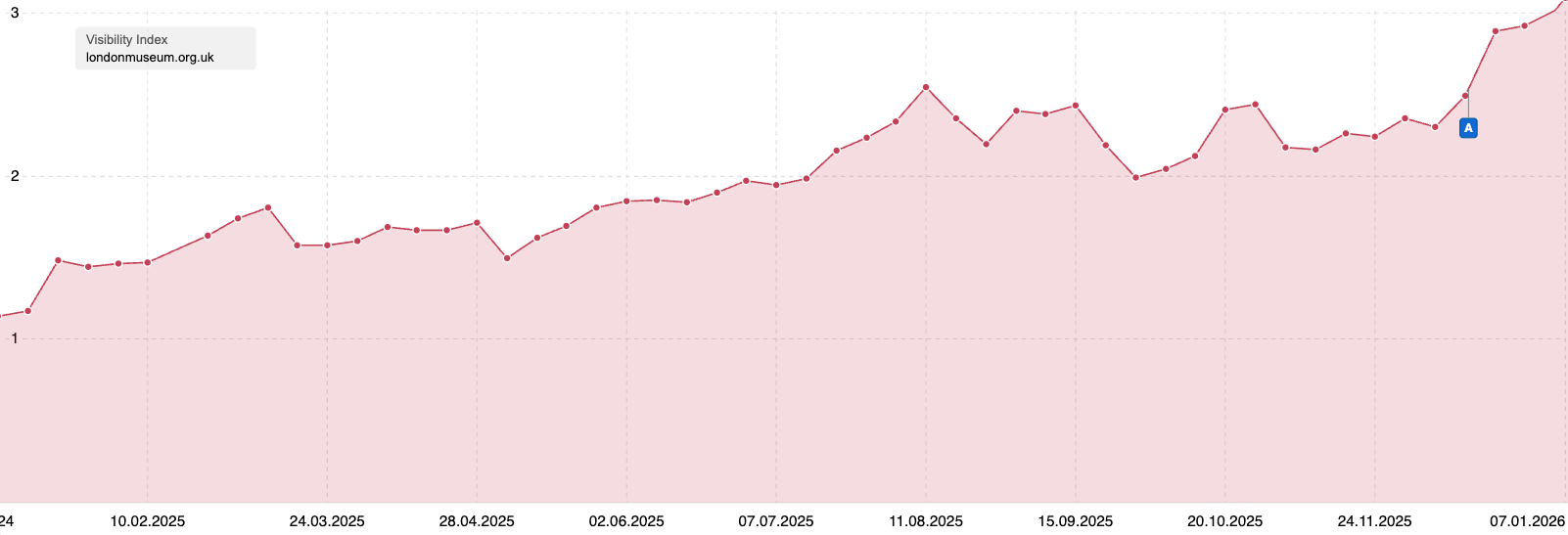
Screenshot from Sistrix showing the London Museum’s visibility index for 2025.
Of these, the London Museum’s performance is probably the most impressive, given that their main location is currently closed and they’ve increased their visibility by building from what was already a relatively decent position (meaning they’re not just picking up easy wins).
Performing arts versus GLAM: a tale of two sectors
We saw a pretty stark contrast between the two major types of organisations featured.
Of the 57 performing arts organisations in our study, 37 (65%) increased their visibility. The average change was +20%.
Of the 38 galleries, libraries, archives and museums, only 12 (32%) improved. The average change was flat, with gains cancelled out by losses.
Why is this? It’s tricky to generalise across such a variety of organisations, but here’s one thing we tend to notice.
Museums usually have a larger and more established SEO footprint, which results in fewer random fluctuations. On the other hand, the relative visibility of performing arts organisations tends to be buffeted by the popularity of their artistic programme, causing more variability from year to year.
It’s also true that (overall - exceptions exist!) performing arts organisations are more likely to have neglected their SEO basics. Maybe some have got wise over the past year, as Google’s AI Overviews have caused overall search traffic to decline.
The organisations that struggled
Eight organisations saw their visibility drop by more than 50%. We’re not going to name names here, but they were:
A producing theatre (-78%)
A regional museum (-65%)
A theatre focused on young audiences (-60%)
A regional museum service (-59%)
A major producing theatre (-57%)
A contemporary art gallery (-54%)
A major art institution (-53%)
An art school and gallery (-51%)
Those are some scary-looking drops, and would be worth digging into.
The causes could be pretty benign. Maybe they had a particularly strong 2024 for some reason (a major exhibition or an anniversary that temporarily boosted visibility), and this is just a return to the mean.
But in some cases, there might be something serious going on that needs fixing. For instance, from a quick look, one of those drops seems to have been caused by a website migration that didn't preserve SEO value properly.
What this means for arts organisations
Search is often the single biggest source of website traffic for cultural organisations, usually driving 40–60% of all visits. If your visibility is declining, that has real implications for audience reach, ticket sales, and engagement with your mission.
The divergence between performing arts and GLAM also suggests that different content strategies may be needed. Transactional content is holding up well. Informational content, the kind that answers questions and provides educational value, is under pressure from AI Overviews (see our recent report on the Impact of AI Overviews in the Cultural Sector).
That doesn't mean abandoning informational content. It means being more strategic: focusing on depth, originality and expertise that AI can't easily replicate, and ensuring your technical SEO foundations are solid enough to compete for the visibility that remains.
How we can help
At One Further, we work with arts and cultural organisations on SEO and content strategy.
If you're seeing declining visibility and want to understand why, or if you want to build on recent gains (or even just understand your current position), we'd be happy to have a conversation. Get in touch.